
Beautiful interfaces may impress stakeholders. Better experiences are what users actually remember.
One lesson I've learned throughout my career is that users rarely judge a product by how modern it looks. They remember whether they completed their task easily, whether they felt confident while using it, and whether the product helped them achieve what they came to do.
That's why I don't believe good UX should be measured only by visual improvements. A redesign isn't successful because it looks cleaner. It's successful because the experience actually becomes better for the people using it.
Good design isn't measured by how beautiful it looks. It's measured by how much easier life becomes for the user.
Why Measuring UX Is Difficult
Measuring user experience isn't as straightforward as measuring revenue or page views. UX is about human behavior, and human behavior is influenced by far more than colors, layouts, or typography.
I've seen projects where everyone celebrated a redesign because the UI looked more modern, only to discover later that users were still making the same mistakes. The visuals improved, but the experience didn't.
That's when I started asking a different question.
Instead of asking, "Does this design look better?" I ask, "Did the experience actually become better?"
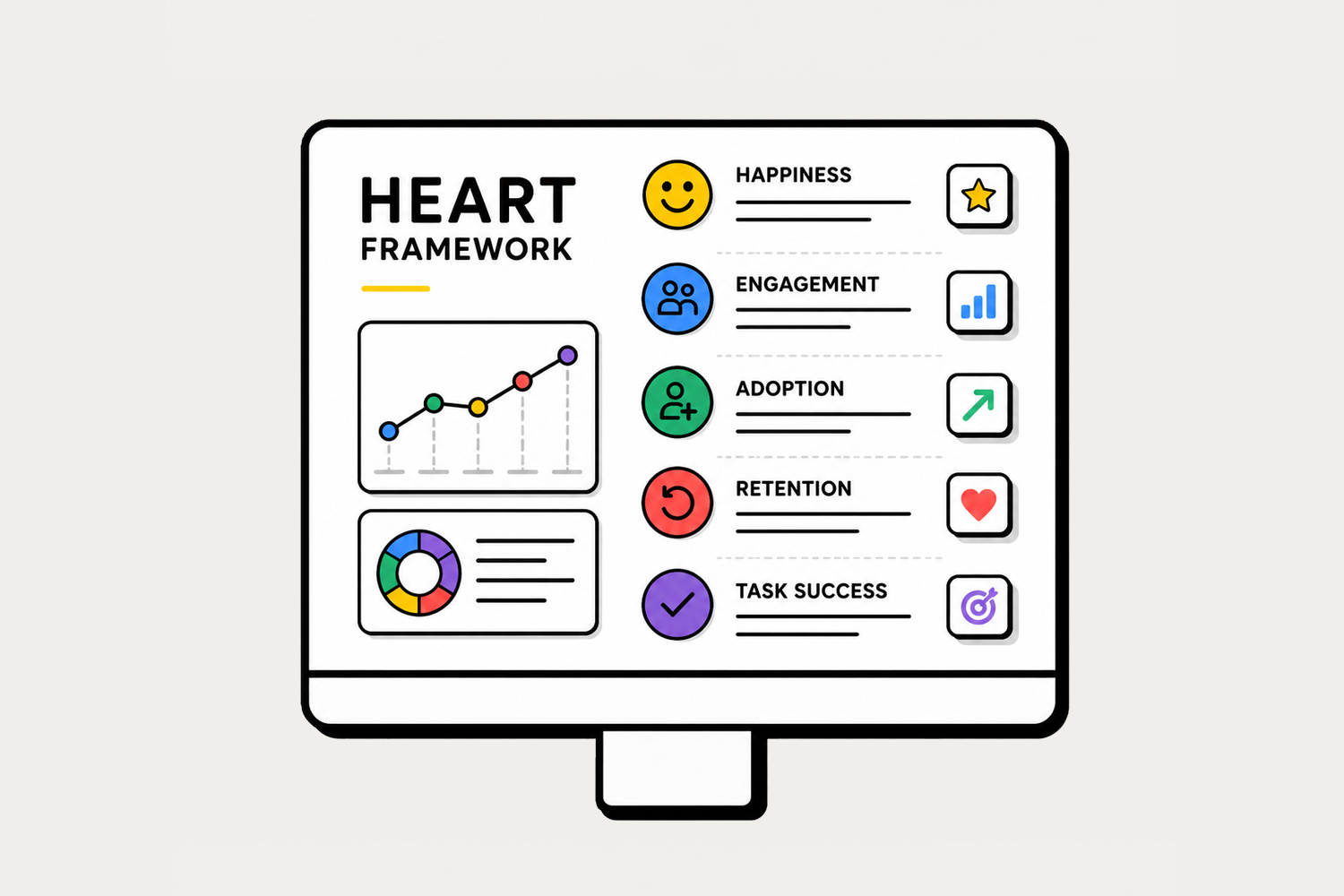
What is the HEART Framework?
The HEART Framework, introduced by Google, provides a practical way to evaluate user experience through measurable outcomes rather than opinions. Instead of asking whether users like a design, it encourages teams to understand whether the product is actually helping people accomplish their goals.
HEART stands for:
- Happiness — Are users satisfied with the experience?
- Engagement — Are users actively interacting with the product?
- Adoption — Are people using new features?
- Retention — Do users continue coming back?
- Task Success — Can users complete what they intended to do?
Not every project needs to measure all five. The framework isn't about collecting more metrics. It's about choosing the ones that best reflect the user's success.
Start With Goals, Not Metrics
One mistake I often see is teams deciding which metrics to track before agreeing on what success actually means.
Imagine redesigning an appointment booking system.
You could measure page views, session duration, or click counts. Those numbers might look interesting, but they don't necessarily tell you if booking an appointment became easier.
Instead, I prefer starting with the user's goal.
Can users schedule an appointment quickly, confidently, and without making mistakes?
Once that goal is clear, the right metrics become much easier to define. Booking completion rate, task completion time, error rate, and user satisfaction suddenly become far more meaningful than generic engagement numbers.
Not Every Product Should Maximize Engagement
One thing I appreciate about the HEART Framework is that it reminds us different products have different definitions of success.
For social media, increasing engagement might be a reasonable goal. But for enterprise software, healthcare systems, or financial products, users usually don't want to spend more time inside the application.
They want to finish their work accurately and move on.
In those cases, reducing effort is often a much stronger indicator of good UX than increasing usage time.
Metrics Tell You What. Research Tells You Why.
HEART doesn't replace user research.
Analytics may tell you that only 65% of users completed a task, but numbers alone won't explain why the remaining 35% struggled.
That's why I see quantitative and qualitative research as complementary rather than competing methods.
- Analytics tells us what happened.
- User research explains why it happened.
The best design decisions usually come from combining both.
Lessons From Real Projects
Throughout my work across enterprise systems, startups, and government platforms, I've learned that users rarely celebrate beautiful interfaces. They celebrate products that help them finish their work with less effort.
Some of the most successful improvements I've worked on weren't dramatic visual redesigns. They were small usability improvements that reduced confusion, prevented errors, and helped users complete important tasks faster.
That's why I believe measuring UX is just as important as designing it. A redesign without measurable outcomes is simply another opinion.
Key Takeaways
- Measure experiences, not just interfaces.
- Start with user goals before defining metrics.
- Choose metrics that fit the product, not the trend.
- Combine analytics with user research for better decisions.
- Great UX is proven by outcomes, not opinions.
"Users don't care how much work went into your design. They care how little work they have to do."